June 10th, 2025 / 14th of Sivan 5785
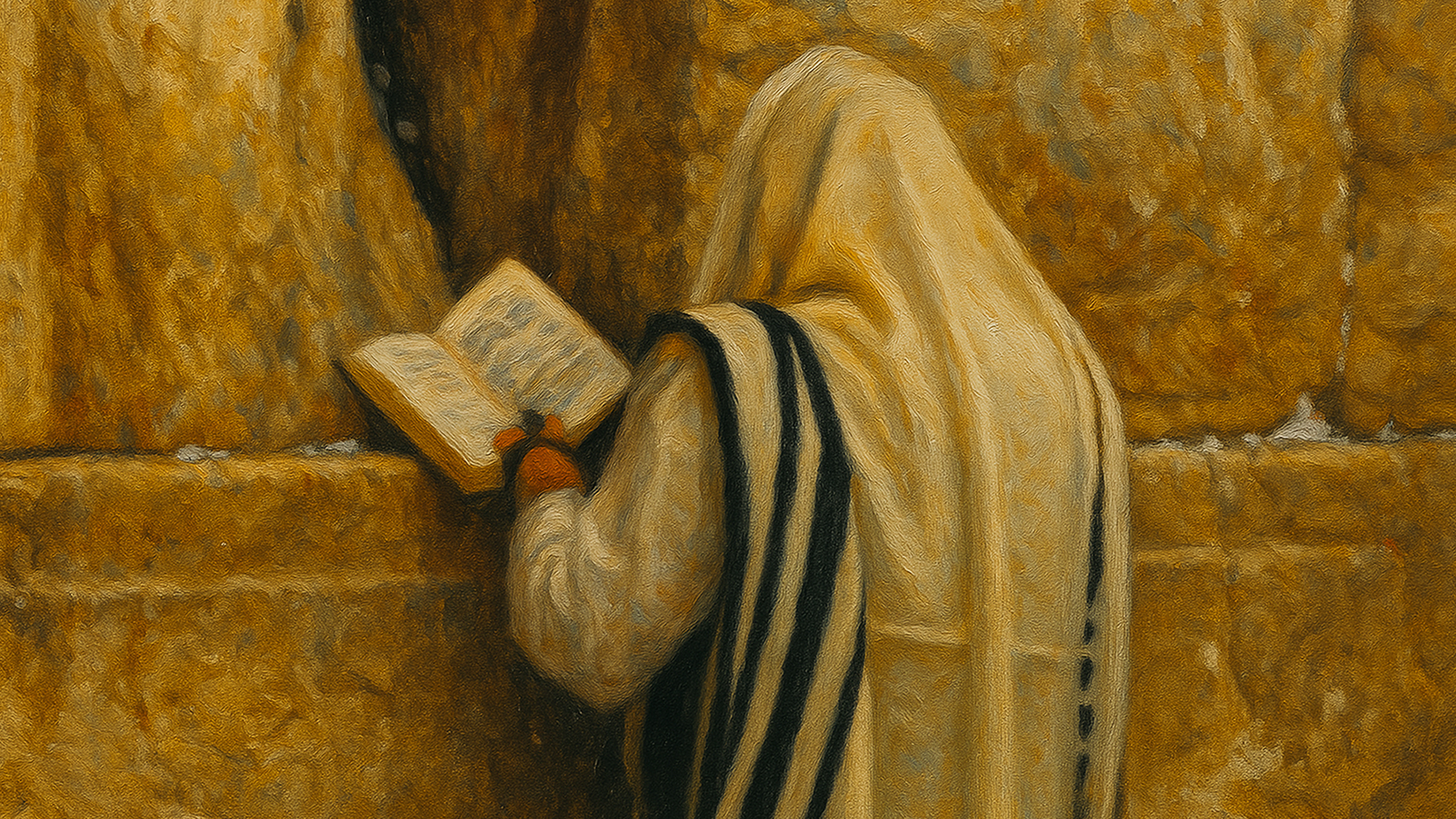
“When you come to war in your land upon the foe that distresses you, you will sound an alarm with the trumpets, and you will be remembered before HaShem [G-d], and you will be saved from your enemies.”
– Bamidbar (Numbers) 10:9
The Rambam [Rabbi Moshe ben Maimon] learned from here that there is a mitzvah [commandment] to pray in a time of distress: ‘And one who is in distress and does not call out to HaShem to save him has nullified this positive commandment.’
The Gemara [Talmud Bavli] in Ta’anis 2a expounded, ‘What is the service of the heart? This is Tefillah [Prayer].’
And in the Yerushalmi (end of Berachos Ch. 5) they said, ‘If one turns his heart during prayer, his prayer is accepted. And what is the reason? ‘You prepare their heart; Your ear listens.”
If we see that our prayers are not being answered, it seems that we are not directing our hearts properly.
And what is demanded of us? The first thing is fulfilling the halachah [Jewish law]. It is ruled in the Shulchan Aruch [Code of Jewish Law] (Orach Chaim 98:1) that when one prays, he must focus in his heart on the meaning of the words he utters with his lips, and he should imagine as if the Shechinah [Divine Presence] is opposite him, and remove all distracting thoughts from himself until only this thought and intention remain—his Tefillah.
And he should imagine as if he were speaking before a human king, for then he would arrange his words carefully and direct his heart fully. All the more so before the King of kings, HaKadosh Baruch Hu, Who knows all thoughts.
And this is what Chassidim and men of action used to do: They would contemplate during their Tefillah until they reached a state of detachment from physicality and an elevation of the power of intellect, reaching close to the level of Nevuah [Prophecy].
And the Rema [Rabbi Moshe Isserles] added, ‘Before Tefillah, one should contemplate the exaltedness of the Almighty, may He be exalted, and the lowliness of man, and he should remove from his heart all human pleasures. And it is forbidden for a person to kiss his small children in a Beis Knesses [synagogue], in order to establish in his heart that there is no love like the love of HaMakom [the Omnipresent].
Even in order to fulfill the halachah properly, we must learn how great the power of Tefillah is, and how much it lies in the hands of every person to change reality through Tefillah.
This naturally leads us to reflect on some deeper questions about what Tefillah truly is.
With this philosophical background in mind, let us now turn to a different set of questions—ones that arise naturally when we reflect more deeply on the idea of Tefillah itself.
The first question: We are all familiar with the words of the Gemara (Berachos 60b): ‘Anyone who knows what HaShem is doing, it is for Torah that He does it.’ And from a young age, we are taught, ‘HaShem will bless you.’ He loves us beyond our efforts and desires our good.’ As we continually say, ‘With an everlasting love have You loved us.’ And in the Evening Prayer we recount HaShem’s love for us again.’
If so, when we are in need and pray to request something from HaShem, is it not true that He already knows better than we do what we truly need, and that He desires our good more than we ourselves do? If so, why do we need to say anything at all? Why must we describe our situation to HaShem and plead before Him?
The Maharal (Netivos Olam, Netiv HaAvodah, Chapter 2) dedicates an entire section to six philosophical challenges regarding the concept of Tefillah. Among them: If HaShem has already decreed an outcome, what purpose does prayer serve? Does HaShem “need” our prayers? If He knows what’s best for us, why should we ask for anything? The Maharal explains that Tefillah is not about convincing HaShem to change His will, but rather a means for the person praying to transform themselves—to awaken humility, dependence, and spiritual readiness to receive the good that awaits them.
The Mabit (Beis Elokim, Sha’ar HaTefillah, Chapter 2) raises a different issue: Why is it appropriate to repeatedly ask HaShem for the same thing? After all, when standing before a human king, asking multiple times for the same request may be seen as excessive or even disrespectful; and if the king intended to grant the request, he would likely have done so the first time. Why, then, do we persist in repeated requests before the King of Kings?
Both the Maharal and the Mabit, each in his own way, reveal that the purpose of prayer is not to “convince” HaShem to act differently, but to reshape ourselves. With each repeated prayer, a person refines their inner world, strengthens their connection to HaShem, and becomes a more fitting vessel to receive blessing. Through persistent Tefillah, we develop deeper trust, greater humility, and a more intimate bond with G-d.
Indeed, the answer to all the questions is one: First, let us state what is well known to all of us, that HaKadosh Baruch Hu created the world in order to bestow goodness upon His creations. However, in order that they not eat “bread of shame,” He placed them first in this world, where they must exert effort to fulfill His mitzvos [commandments], and through that merit, they will be worthy of Olam HaBa [the World to Come].
It is also known that HaShem governs everything that occurs in this world, but in order for man to have free will, He conceals His governance beneath a veil of nature. And in the natural system, it appears as though everything occurs on its own through a process of cause and effect.
But the truth is that behind every small and great event, the hand of HaShem is present. It is He who grants wealth or takes it away, who gives life or takes it, who humbles the proud and raises the lowly. As Yeshayahu said (Isaiah 45:15), ‘Indeed, You are G-d, Who hides Himself.’
However, the management of the world in this manner is still lacking and endangers the ultimate purpose, because man is liable to forget his Creator and believe that everything is natural and coincidental.
Therefore, HaKadosh Baruch Hu embedded in the structure of the world the institution of Tefillah, so that through it, man would remember the essential truth, that HaShem is the One who governs Creation, He is the One who heals the sick, sustains all creatures, the cause of all causes and the ultimate source of everything.
And to Him one must turn, whether in times of success or, Heaven forbid, in times of distress.
These are the words of the Ramchal [Rabbi Moshe Chaim Luzzatto] (Derech HaShem, Part 2, Chapter 5): ‘According to how much a person becomes entangled in worldly matters, so too he becomes distanced from the supernal light and more darkened. But behold, the Creator, may His Name be blessed, prepared a remedy for him: It is that man should draw near, stand before Him, may He be blessed, and from Him request all his needs, and upon Him cast all his burden… until it becomes natural that even as he engages in the rest of his efforts, he will not become overly absorbed or immersed in materiality and physicality, for he has already preceded all and placed his trust in HaShem.’
The Ramchal also writes (ibid., beginning of the chapter), ‘Among the systems arranged by the Supernal Wisdom is that in order for prophets to receive influence from Him, may He be blessed, they must awaken themselves toward Him, and draw near before Him. And according to their awakening, so too the influence flows upon them. But if they do not awaken, the influence will not flow to them.’
These words are awe-inspiring. To what extent Tefillah is an inseparable part of the world’s rainfall system! If we do not ask, the heavens do not give!
So we find from the very first moment of creation, and the verse is explicit (Bereishis / Genesis 2:5), ‘And all the shrubs of the field were not yet on the Earth, and all the herbs of the field had not yet sprouted, for HaShem Elokim had not caused it to rain upon the Earth, and there was no man to work the soil.’ As Rashi explains, ‘There is no rainfall without the need for rain; and when man came and understood that the world needs it, he prayed for it, and the trees and grasses sprouted.’
So, too, the Gemara says (Chullin 60b), ‘For years, clouds rose and hovered over the entrance to the tear in the heavens until Adam HaRishon [the First Man] came and requested mercy upon them, and then rain fell and vegetation grew.’ To teach that HaKadosh Baruch Hu desires the prayers of the righteous.
From the same verse (ibid.): Rav Nachman bar Chisda had a garden. He planted it but it did not sprout. He prayed for mercy and rain fell, and it sprouted. They said, ‘This is what we meant when we said that HaShem desires our prayers!’
How awesome!
At the moment of the Revelation at Har Sinai [Mount Sinai], there was a great time of divine favor, and the Yeitzer HaRa [Evil Inclination] was uprooted from their hearts (Shir HaShirim Rabbah 1:15). And HaKadosh Baruch Hu said (Devarim /Deuteronomy 5:26), ‘Who would grant that this heart of theirs be always like this, to fear Me and keep all My mitzvos, so that it may go well with them and their children forever.’ And our Rabbis said (Talmud Bavli, Avodah Zarah 5a) that at that moment they should have said, ‘You give it,’ but they did not say it.
We could have merited to be permanently fixed in the level of awe and acceptance of the yoke of mitzvos, just like at the moment of Matan Torah [the Giving of the Torah]!
But because they did not ask, they did not receive, and the moment passed!
Thus we learn that Tefillah is a form of preparation for fulfilling the entire Torah, for it creates the continuous bond between a person and his Creator. Through Tefillah, a person acknowledges that everything is from HaShem. And in the words of the Kuzari, ‘Tefillah is to the soul what nourishment is to the body.’
Evening, morning, and afternoon, we need Tefillah to connect us with our Creator, and just as a person needs to eat several times a day, so too, he needs Tefillah.
Even more than that, Tefillah overturns nature. And since this is so, the nature that the Holy One, blessed be He, embedded in the world was that it should be reversed and subjugated to Tefillah. And if a person is not worthy, he does not receive what was prepared for him.
Even more than this, the Holy One, blessed be He, gave us prayer, and it nullifies decrees, as we were shown in the Exodus from Mitzrayim (Egypt).
Upon the People, it was decreed that they would be enslaved for four hundred years in bitter and harsh servitude (Bereishis 15:13): ‘They will enslave them and oppress them for four hundred years.’
But they only endured 209 years, and Moshe Rabbeinu was sent to redeem them. And why? This was also the question Moshe Rabbeinu asked. ‘What merit do they have in their hands?’ And HaShem answered him, ‘They do not have even a single merit (Rashi, Shemos / Exodus 3:11).
Tremendous debts. They were idol worshipers (Yechezkel / Ezekiel 20:8) and were sentenced to be killed: ‘They rebelled against Me and did not wish to listen to Me.’ The Egyptians and others asked, ‘What makes these ones different from these?’ There was no distinction between the Jews and the Egyptians (Vayikra / Leviticus Rabbah 23:2); they were among the most defiled of all nations (Rashi, Vayikra 18:2).
So in what merit were we redeemed? Because they cried out from the depths of the heart!
As it is said (Shemos 2:23), ‘And their cry rose up to Elokim.’ And later (Shemos 3:7), ‘I have surely seen the affliction of My people that are in Mitzrayim, and their cry I have heard… and I have come down to deliver them.’
And therefore, because of this, we were commanded to mention redemption daily in the Tefillah (Berachos 4b).
This is to say, even if a harsh decree was issued, and the time of salvation and relief has not yet come, and we possess no merits, only dreadful sins, we must cry out, and we will be saved!
Excerpted and translated from Hebrew into English from Yam HaTorah by Rabbi Yosef Goldstein, Rabbi and Mussar Lecturer at Diaspora Yeshiva Toras Yisrael, Mount Zion, Jerusalem.
Share This!
From beginner to advanced, if you’re a Jewish man, 18 to 35 years of age, and you’re ready to give your heart to HaShem, and to get serious about learning Torah, Diaspora Yeshiva has a place for you with us on Mount Zion, Jerusalem.
