‘Speak to the Children of Yisrael, and say to them, ‘If any man’s wife go astray, and acts unfaithfully against him…”
– Bamidbar (Numbers) 5:12
Rashi [Rabbi Shlomo Yitzchaki] explained, ‘”Ki tisteh ishto” [If his wife will go astray]. Our Rabbis have taught adulterers do not commit adultery until a spirit of foolishness enters them’ (Talmud Bavli, Sotah 3a).
This is the way of the Yeitzer HaRa [Evil Inclination]: to entice a person with dimyon [imagination] and falsehood, with arguments based on nonsense. As stated in the Gemara [Talmud] (Sanhedrin 63a), ‘Rabbi Meir had three hundred fox parables, and we have only, “Avos achlu boser” [‘The fathers ate sour grapes’]’.
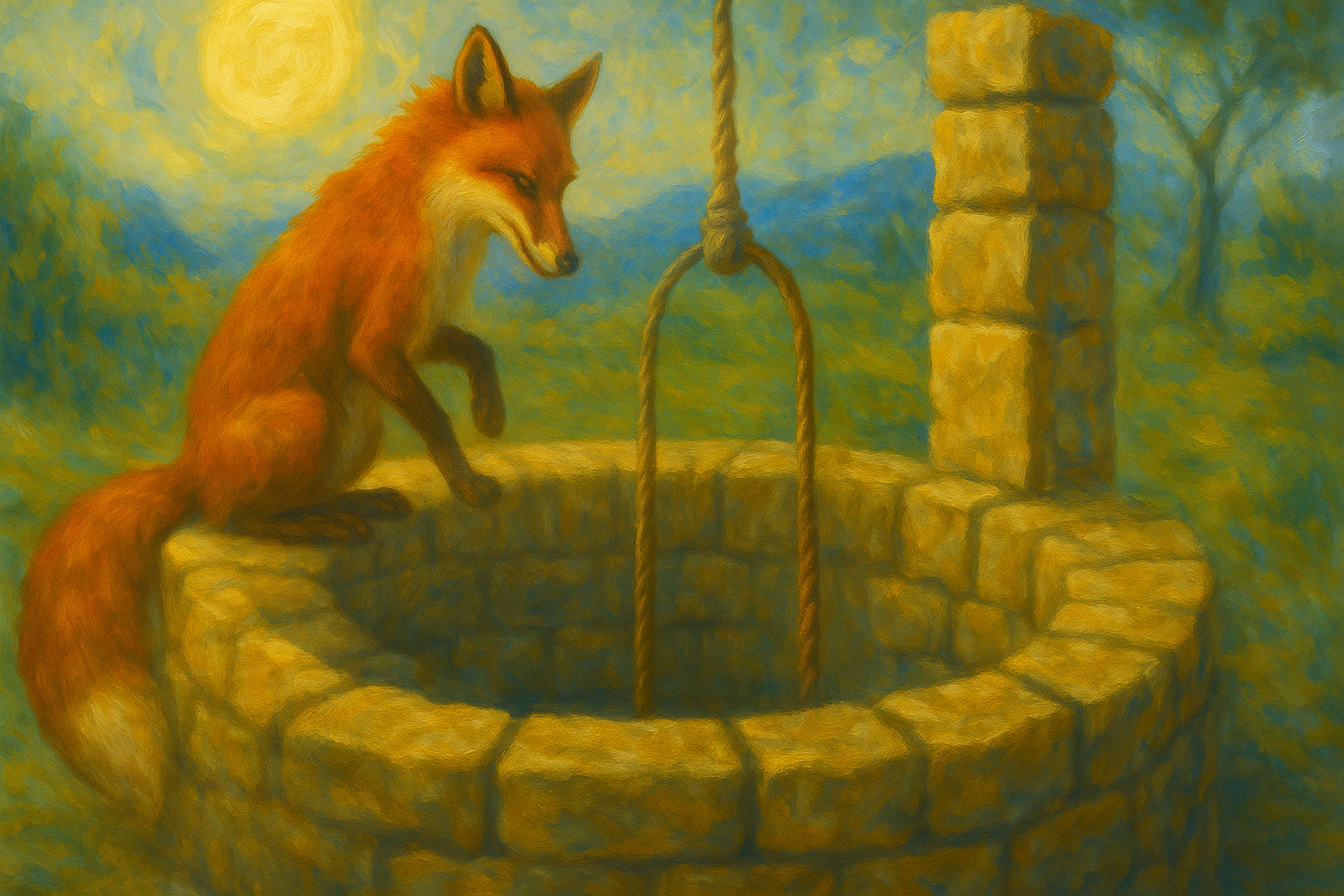
Rashi explained, ‘The fox tricked the ze’ev [wolf] into entering the courtyard of the Yehudim [Jews] on Erev Shabbos [the eve of the Sabbath] to help them prepare for the meal and to eat with them on Shabbos. But when he came to enter, they gathered against him with sticks, and he fled for his life, beaten and wounded.
‘The ze’ev came to kill the shual [fox]. The fox defended himself and said to him, ‘They didn’t beat you except because of your father, who once started to help with a meal and ate every good portion.’
‘He said to him, ‘Because of my father I am being beaten?’ He replied (Yirmiyahu / Jeremiah 31:29), ‘The fathers ate sour grapes, and the children’s teeth are set on edge. But My people came and saw a place to eat and be satisfied.
‘They came to a be’eir [well], and on its edge two buckets were rolling—when one rises, the other descends. The shual entered the upper bucket, which was heavier, and went down; and the lower bucket rose.
‘The ze’ev said to him, ‘Why did you go down there?’
‘He answered, ‘There is meat and cheese here to eat and be satisfied,’ and he showed him the reflections of the moon in the water, like round wheels of cheese.
‘He said to him, ‘How can I descend?’
‘He told him, ‘Enter the upper bucket.’ He did so, and as it was heavier, he went down and the bucket that the shual was in rose.
‘He said to him, ‘How do I get out?’
‘He answered (Mishlei / Proverbs 11:8), ‘One who is righteous is rescued from trouble, and the wicked comes in his place.’
‘And the righteous gaon [genius] Rabbi Yaakov Galinsky ztz”l asked, ‘How was the ze’ev so easily convinced by the shual’s promise that they were waiting to help him prepare for Shabbat? And how did he believe the excuse that it was all because of his father? Even after seeing how he was fooled once, why did he go down into the well again?’
‘The answer: The shual promised meat and cheese. And in the end, what was it? The cheese was just the reflection of the moon, and the meat—not even a metaphor. Had the ze’ev devoured the shual, he would have been satisfied and spared beatings and captivity.
‘Even so, we too—if only we had overcome the Yeitzer HaRa—I too would have been satisfied.’
And our Sages said (Sanhedrin 107a), ‘He who starves it becomes satiated.’ We would have been spared so much. But we were lured after illusions, and the one who is lured, even from this place he is taken, and he finds himself imprisoned by his own yeitzer [inclination].
This is the way of the Yeitzer HaRa—to confuse a person with fantasies:
‘If you leave the yeshiva [Torah study academy] and go to work, you will become rich, you will have a happy life, full of good things.’
And all of it is vain and misleading promises. Like the story in Seifer HaDevarim Chayim [The Book of the Living Words] about the man who heard an egg, and began to imagine how from the egg would hatch a chick, which would grow into a hen that lays eggs, which would multiply until he had a large coop, etc. And immediately, as he was lost in his dimyon, the egg fell and broke.
So is the way of the Yeitzer—to distract a person from his Torah learning, and also from other mitzvos [commandments], and into vain illusions.
This is the spirit of shetus—it does not let a person think clearly, and he is drawn after the Yeitzer HaRa.
And similarly we find (in the Gemara, Shabbos 30b) that the Yeitzer HaRa wanted to kill David HaMelech [King David], but was unable because he was immersed in Torah study without interruption.
What did he do? He caused a noise in the garden of David’s house. David paused from his learning and got up to see what was happening in the yard, and then the Mal’ach HaMavet [Angel of Death] could seize him and kill him.
Likewise, the Gemara (Talmud Bavli, Moed Katan 28a) tells that the Yeitzer HaRa used the same tactic to try to kill Rabbi Chiyya and Rav Chisda.
This is the way of the Yetzer—to defeat a person through schemes, even with absurd and foolish lies.
Therefore the resha’im [wicked people] are filled with regret. Because every time they fall again, they are newly seduced, deceived by another promise—some pleasure that vanished and was lost.
Truly, we are not to fight the dimyon itself, because dimyon can be a powerful tool in avodat HaShem [the service of G-d].
Dimyon awakens ambition in a person to grow in Torah and yirah [fear/awe], and kinas sofrim [jealousy among scholars], and preserves wisdom.
So too, dimyon often helps a person understand his learning properly.
But like every trait that Hashem gave us, we must know how to manage it properly according to the will of the Creator.